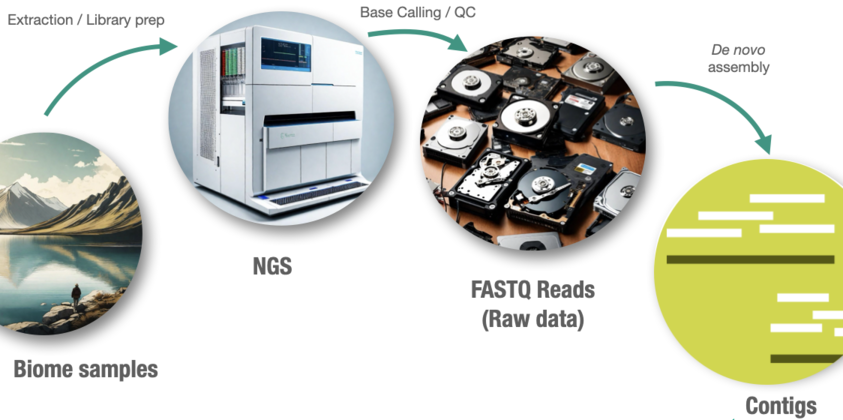
This workshops introduces some core concepts and basic skills in the analysis of whole metagenome shotgun experiments.
The goal is to present:
- What information we can extract from the gDNA sequencing of a microbial community (whole metagenome shotgun)
- The difference between read based approaches (profiling) and de novo assembly (MAGs)
- How to evaluate the quality of the sequencing and how to remove unwanted reads (QC, host removal,…)
What we will learn to do
In terms of tools we will:
- Remove host reads using Hostile (and other methods)
- Perform a taxonomic profiling (who is there?) of the prokaryome using MetaPhlAn 4 and the overall profiling using Kraken2, comparing the advantages and disadvantages of each tool
- Perform a functional profiling (what are they doing?) using HUMAnN
- Assemble the reads with MegaHit, to produce a set of contigs. We will see what a co-assembly is and when it’s useful to do it
- See how to perform the backmapping (sometimes called read recruitment), and what information we can extract from the coverage tracks, using CoverM
- Try to group contigs belonging to the same genome (Binning), using SemiBin2
- Evaluate the completeness and contamination of bins (CheckM2, BUSCO), and see how to dereplicate them with dRep, and how to assign a taxonomy using GTDBtk
- Finally, we will see how to perform manual binning and explore metagenomics assemblies using Anvi’o
Next submodule:
Overview